Digital Product Passport in the EU: what does DPP mean for businesses from 2026?
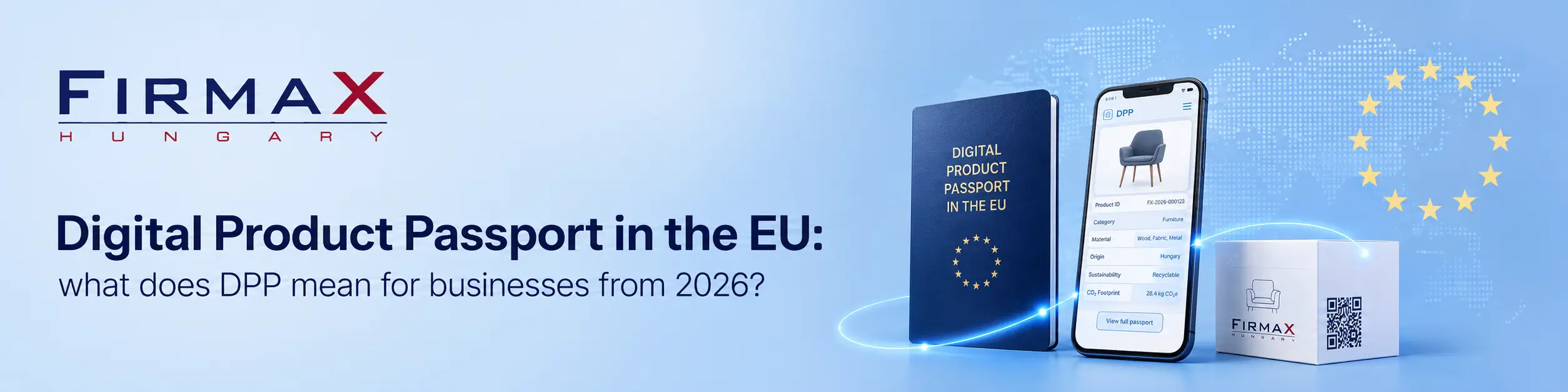
The EU’s Digital Product Passport system entered the operational phase in 2026. We will show you how the digital product passport works, which businesses may be affected, what data can be included in it, when the first obligations will appear, and what you should prepare for now.
The Digital Product Passport is no longer just a future EU plan
The European Union’s product regulation is increasingly moving towards a system in which the origin, composition, technical characteristics, compliance, reparability and life cycle of a product are also available as structured digital information. One of its central elements is the Digital Product Passport, or DPP for short.
The system reached an important milestone in the summer of 2026. On 20 July 2026, the European Commission launched the EU Digital Product Passport Registry and the related sandbox. With this, the DPP will gradually move from the level of a legislative concept towards a truly functioning European digital infrastructure.
The Registry acts as a central EU index that manages the unique identifiers, registration data and specific metadata associated with Digital Product Passports. One of the main objectives of the system is to ensure that product information can be managed in a more consistent, standardised and verifiable form throughout the EU’s single market.
At the same time, it is important to note that the launch of the Registry does not mean that from July 2026, it will be mandatory to create a digital product passport for all products sold in the European Union. DPP rollout is incremental and incremental by product group. The specific obligation is always determined by the EU legislation applicable to the product in question or by a product-specific rule adopted at a later date.
What is a Digital Product Passport?
DPP is often identified with a QR code, but a Digital Product Passport is much more than just a code.
A DPP is essentially a structured digital dataset that relates to a specific product, component, or material. A data intermediary creates a connection between the physical product and the digital information. This can be a QR code, for example, but the technology used can also depend on the rules that apply to the specific product group.
The aim of the system is not merely to inform consumers. Data from the same product can be important to different actors from different perspectives. A customer may be interested in the origin or durability of the product, a repairer may be interested in parts and assembly information, a recycler may be interested in the material composition, while a customs or market surveillance authority may be interested in the identification and legal compliance of the product.
The Digital Product Passport can therefore be seen as an information infrastructure that can link data related to production, sales, use, repair, reuse and recycling throughout the product life cycle.
One of the most important legal bases of the system is the Ecodesign for Sustainable Products Regulation, or ESPR for short. This regulation establishes a framework, while the detailed requirements for each product group will be set out in separate legal acts.
What information can be included in the Digital Product Passport?
There is no single single DPP data sheet that can be applied to all products in the same way. A battery, a textile product, a steel product, a tyre or a piece of furniture has a significant difference in life, technical properties and environmental impact.
The specific scope of data is therefore always determined by the regulations applicable to the given product group.
Depending on the nature of the product, the Digital Product Passport may include information on the identification and origin of the product, materials and components used, technical and safety characteristics, durability information, repairability data, environmental performance, and information supporting reuse and recycling.
For certain products, the DPP may also contain information about use, maintenance, disassembly, or repair.
From the point of view of businesses, this is particularly important because many companies do not currently have these data in a single system. The material composition can be in a supplier documentation, the technical information in a company database, the environmental data in a separate report, and the production data in an ERP system.
Therefore, the gradual introduction of DPP may not only mean a new compliance obligation, but may also require a transformation of enterprise product data management.
All data will not be in a single central EU database
One of the important features of the DPP system is that it combines central and decentralized elements.
The EU Digital Product Passport Registry does not necessarily store all the details of the entire product passport. The Registry primarily manages unique product identifiers, registration data, and certain high-level metadata.
The relevant economic operator will continue to be responsible for detailed product data. These can be maintained in your company’s own system or, where appropriate, through a third-party DPP provider.
This also means that the DPP is not simply another EU database to which all documents need to be uploaded. Rather, the goal is to create a networked system in which the product has a reliable digital identity, while the detailed information related to it remains properly structured and accessible.
Access rights may also vary. Not all DPP data may be publicly available to everyone. Other information may be accessed by the consumer, other data by the repairer, recycler or an authority.
The EU DPP Registry will be operational in 2026
Launched on July 20, 2026, DPP Registry is one of the key technical elements of the new system.
Economic operators can register the identifiers and required metadata for Digital Product Passports through the system. The system supports integration via both user interface and API, so that larger companies can later directly connect their own corporate IT systems to the EU registration infrastructure.
This can be particularly important for companies that place large quantities of products on the EU market, as manual DPP registration would not be realistic in the long run.
Technical standardisation is also at an advanced stage. The functioning of the EU system requires common solutions to ensure that different enterprise systems, authorities and DPP providers can interpret the same data in the same way.
DPP is therefore not a simple document digitization. The EU is working to create an interoperable system that can link product data between different sectors and regulatory systems in the longer term.
Who can be responsible for the Digital Product Passport?
When determining liability, it is not enough to examine only who physically manufactured the product.
Depending on the specific legislation, the economic operator that places the product on the European Union market may be responsible for establishing, maintaining and maintaining the DPP and the accuracy of the data.
This is particularly important for manufacturers outside the EU.
For example, if a US, Chinese or other third-country manufacturer sells a product in the European Union that is already subject to a DPP obligation, the EU importer or other relevant economic operator cannot ignore these requirements on the grounds that the product was not manufactured in the EU.
The Digital Product Passport is therefore not a system exclusively for European manufacturers. It may also affect foreign products entering the EU market.
However, the specific responsibilities are always product-specific, so companies should examine the legislation applicable to the product separately. In this process, it may be justified to use appropriate legal support in Hungary to determine precisely what role the given company plays in the supply chain and what obligations may be related to it.
The first major mandatory application: the battery passport
The first specific and more widely significant application of the DPP system is related to batteries.
For certain battery types, the Battery Passport will become mandatory from February 18, 2027.
This may concern, among others, batteries used in certain electric vehicles, batteries for light electric vehicles, energy storage batteries and specific industrial batteries.
The Battery Passport illustrates how DPP will work in practice.
The product is linked to a QR code that gives you access to the digital information you need. This data may include identification and technical information, information on the manufacturer and other economic operators, performance and durability information, and information supporting repair, reuse and recycling.
This is the first major product category through which the technical and legal operation of the DPP will be more widely visible in practice.
Which product groups can follow?
Under the ESPR, the European Commission has identified a number of product categories that will be prioritised in the coming years.
According to the current EU roadmap, regulatory preparations for iron and steel products could proceed in 2026, for textiles, tyres and aluminium in 2027, for furniture in 2028, and for mattresses and some ICT products in 2029.
However, this does not mean that all such products will be subject to mandatory DPPs from the first day of the given year.
The specific rules for a given product group must be adopted separately and specify the mandatory data content, the technical requirements and the start of application.
For product-specific rules adopted under the ESPR, businesses should, as a general rule, be given at least 18 months to prepare.
This is important because in many cases, DPP is not simply a new label or document. To comply with the requirements, the company may also need supplier data collection, IT development, the establishment of internal responsibilities and the modification of contractual documentation.
DPP does not apply to all products in the same way
It is a common misunderstanding that the Digital Product Passport will soon become a general obligation for all products sold in the EU.
The ESPR explicitly excludes certain product categories from its scope, and for other products, specific EU legislation may specify how digital product data is handled.
Therefore, businesses should not ask in general terms “whether they are covered by the DPP”, but which EU legislation applies to the specific product they market and whether they contain or are expected to include a DPP obligation.
This is particularly important for foreign companies that enter the European market with several different product categories.
The relationship between DPP and customs control
The importance of the Digital Product Passport does not end with consumer information.
One of the tasks of the DPP Registry is to support the audit work of customs and market surveillance authorities. Customs authorities will be able to check electronically whether an imported product for which the DPP is mandatory has a properly registered Digital Product Passport.
In the long run, this can significantly change the way import compliance works.
Product identification, customs clearance, compliance documentation and digital product passport can be increasingly interconnected. An inadequate or incomplete DPP may therefore not only be a documentation problem, but may also have a direct impact on the product’s access to the EU market.
It is therefore advisable for companies entering the Hungarian or other EU market to treat the DPP requirements together with product compliance, import and licensing and regulatory procedures , rather than as completely separate administrative tasks.
The real challenge is not the QR code
One of the most important practical lessons of the Digital Product Passport is that creating a technical entry point can be relatively simple. Making a QR code is not a major technological challenge in itself.
The more difficult question is what is behind the QR code.
Product data must be accurate, properly structured, up-to-date and, where appropriate, available over a long period of time. The business must also be able to prove the origin and reliability of the data.
This can be particularly challenging for complex international supply chains.
For example, a European importer can only provide the exact material composition, origin or certain environmental data of a product if this information has been properly collected and transmitted by the manufacturer and upstream actors in the supply chain.
DPP can therefore also affect supplier contracts. In the future, it may become more important to contractually record what data the supplier is obliged to provide, in what format, with what frequency, and what responsibility it assumes for their correctness.
What should a business do as early as 2026?
For most businesses right now, the right reaction is not to buy a full DPP platform right away.
The detailed rules for many product groups are still being developed, so it is too early to invest in a technical system that may not meet the specific regulatory requirements at a later stage.
It is better to start preparing on the data page.
It is advisable for the company to examine the technical, origin, material composition, environmental and reparability data currently available for the products it distributes.
It is also worth looking at the systems in which this information is located, who is responsible for it, how often it is updated, and how easily it can be made available in a structured digital form.
Another important area is the mapping of the supply chain. If a future DPP requirement requires data that can only be found from a third-country manufacturer, the company must be able to obtain this information in an appropriate format.
Preparing for the DPP can therefore become a joint project between the areas of procurement, legal, compliance, logistics, product development and IT.
From administrative burden to business infrastructure
The Digital Product Passport will undoubtedly create new compliance obligations, but in the longer term it should not necessarily be seen solely as an administrative burden.
Structured product data can improve corporate traceability, aid quality control, simplify regulatory processes, and support circular business models.
A well-functioning DPP system can also benefit the processes of repair, sale of used products, returns, remanufacturing and recycling.
The DPP could therefore become an essential element of the digital identity of the product in the European market over time.
What does this mean for businesses operating in Hungary and abroad?
The Digital Product Passport is an EU market system, so a Hungarian company and a foreign company entering the EU market through Hungary are basically faced with the same question: whether the given product enters the European Union market and whether it is subject to a product-specific regulation that requires a Digital Product Passport.
Of course, the establishment of a company in Hungary, tax registration or accounting alone does not settle product compliance obligations.
Entering the EU market is therefore increasingly a complex process in which corporate, taxation, customs, product compliance, licensing and supply chain requirements need to be addressed in a coordinated manner.
This is particularly important for third-country companies that use Hungary as the starting point for their European subsidiary, import structure or distribution activities.
Conclusion
By the summer of 2026, the Digital Product Passport will no longer be solely a future EU regulatory concept.
The EU Digital Product Passport Registry became operational on 20 July 2026 and the first major mandatory digital product passport system for certain batteries will be introduced from 18 February 2027.
In the coming years, additional product groups may be gradually included in the scope of the DPP, including textiles, iron and steel products, aluminium products, tyres, furniture and certain ICT products.
However, the most important question for businesses right now is not what QR code or software platform to use.
It is much more important to understand what product data they have, where this data comes from, how reliable it is, how it can be updated, and whether the company can manage it in a structured way throughout the supply chain.
In the long run, the Digital Product Passport will not simply be a new label on the product. A digital compliance and information infrastructure is being built that can significantly transform the way products are identified, documented, imported, verified, repaired and recycled in the European Union.
FirmaX Hungary supports Hungarian and international businesses in company formation, accounting, taxation, registered office and business administration tasks related to entering and operating in Hungary, as well as in the coordination of the related legal, licensing and compliance areas if necessary.