From Import to EU-Wide Distribution: How to Build a European Logistics Hub in Hungary
A practical guide for non-EU manufacturers and investors
For manufacturers and investors based outside the European Union, entering the European market can be challenging when every customer order must be shipped separately from a third country. Customs procedures, import taxes, long delivery times and changing logistics costs can make expansion difficult and reduce competitiveness.
A Hungarian distribution company can offer a more efficient alternative. Instead of supplying each European customer directly from abroad, products can be imported into Hungary in larger quantities, customs-cleared, stored locally and then distributed to customers across the European Union.
This model can turn a non-EU manufacturer into an EU-based importer and distributor with local inventory, shorter delivery times and more direct access to European customers. It can also create a clearer operational framework for VAT, warehousing, logistics and customer service.
However, company registration and warehouse rental alone are not enough. Customs, VAT, product compliance, inventory management and transaction documentation must be designed as one integrated system.
This guide explains how a Hungarian logistics hub can work in practice, which decisions must be made before the first shipment and what documentation is needed to support the structure.
- How the Hungarian distribution-hub model works
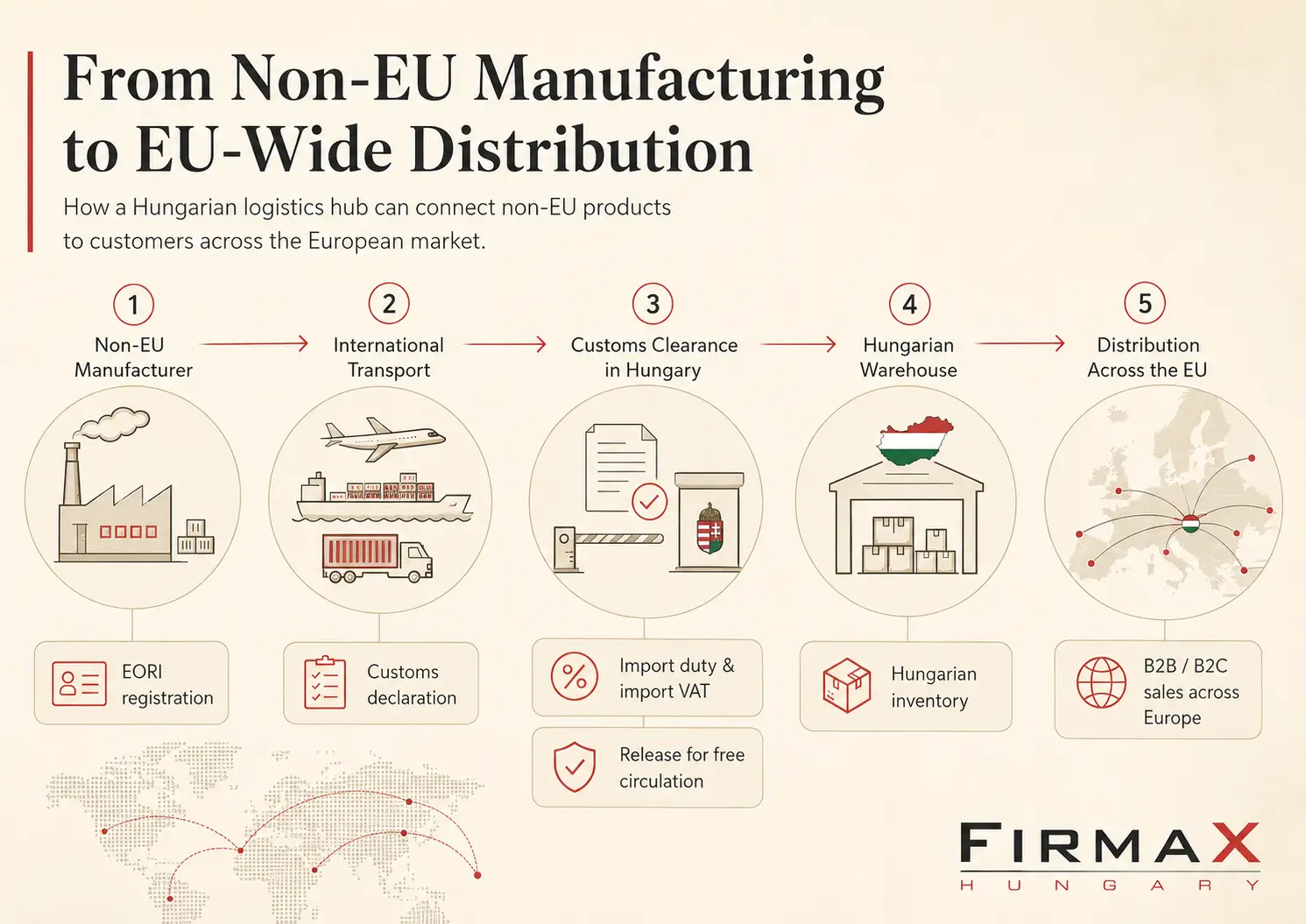
The basic structure is relatively straightforward.
A non-EU investor establishes a Hungarian company that acts as the European importer and distributor. Products manufactured outside the EU are shipped to Hungary, declared to customs and either released for free circulation or placed under a customs-storage arrangement.
After customs clearance, the goods are stored in a Hungarian warehouse. The Hungarian company then sells them to customers in Hungary or other EU Member States.
The main commercial advantage is that the products enter the EU in larger shipments rather than being imported separately for each customer. Once the goods have been properly released for free circulation, they generally do not require a new import customs procedure merely because they are later transported from Hungary to another EU country.
This allows the business to hold European stock and deliver orders more quickly. It can also simplify freight planning, make landed costs more predictable and provide customers with an EU-based contractual partner.
Nevertheless, every later sale must still be treated correctly for VAT purposes. Product compliance, transport evidence and reporting obligations also remain relevant after the initial import has been completed.
- Choosing the company that will act as importer
The first important decision is identifying the entity that will legally and economically control the European operation.
In a typical structure, the Hungarian company purchases the products from the overseas manufacturer, appears as importer in the customs declaration, owns the inventory and sells the goods to European customers.
This alignment is important because the commercial documents, customs declaration, accounting records and VAT treatment should all reflect the same business reality.
Problems can arise when different entities appear in different parts of the transaction. For example, the overseas parent company may issue the purchase contract, the customs declaration may identify a logistics provider as importer and the Hungarian subsidiary may later attempt to deduct the import VAT.
Such arrangements are not necessarily impossible, but they require careful planning. The party claiming import VAT should generally be able to demonstrate that it was the relevant importer or consignee and that the imported goods are used for taxable business activities.
Before the first shipment leaves the manufacturing country, the parties should therefore determine who owns the goods during transport, who bears the customs and tax costs, who is responsible for product compliance and who will sell the stock after importation.
The Incoterms used in the contract should support this structure rather than contradict it.
- EORI registration and customs representation
A Hungarian tax number or EU VAT number does not automatically allow a company to complete customs procedures. An EORI number is also required.
EORI stands for Economic Operators Registration and Identification. It is the identification number used by customs authorities throughout the European Union.
The Hungarian distribution company normally needs an EORI number before it can submit import or export declarations, use customs transit procedures or apply for certain customs authorisations.
This registration should be completed before the first shipment departs. Delaying the application until the goods have already arrived may cause storage costs, customs delays and additional administration.
Most businesses work with a customs representative or freight forwarder. The scope of that representative’s authority should be clearly documented.
The company must understand whether the customs agent is acting through direct or indirect representation, as this can affect responsibility for the customs debt and the accuracy of the declaration.
Even when an experienced customs broker is involved, the importer remains responsible for providing correct information about the product, value, origin and intended customs procedure.
A customs agent can submit the declaration, but it cannot safely determine the correct tariff classification or origin without reliable information from the importer and manufacturer.
- Product classification determines the import treatment
Every imported product must be classified under the EU customs tariff.
The customs code affects the duty rate, import restrictions, tariff quotas, anti-dumping measures and various product-specific obligations. It can therefore have a direct impact on the profitability of the distribution model.
A short commercial description on a supplier’s invoice is rarely sufficient for accurate classification. Customs treatment may depend on the product’s material composition, function, technical characteristics or intended use.
For this reason, the Hungarian importer should collect detailed specifications before calculating the landed cost. Technical drawings, catalogues, photographs, ingredient lists and information about components may all be necessary.
Where classification is uncertain and the financial consequences are significant, the company may consider requesting Binding Tariff Information. This provides an official customs decision on the tariff classification of a specific product.
Classification should not be treated as a formality completed only when the goods arrive. It should form part of the commercial planning process.
A business model that appears profitable under a low customs-duty rate may become considerably less attractive if the actual classification results in a higher rate or an anti-dumping duty.
- Customs value and related-party pricing
Import duty is normally calculated on the customs value of the goods.
In many cases, the starting point is the price paid or payable for the products when they are sold for export to the European Union. However, the customs value may also require adjustments.
Freight and insurance costs up to the EU entry point, packaging costs, certain commissions, royalties or materials supplied by the buyer may need to be included.
This becomes particularly important when the Hungarian importer purchases products from a related non-EU manufacturer.
The intercompany price may be influenced by the group’s transfer-pricing policy, but customs valuation and corporate income tax do not always approach the same price in exactly the same way.
A transfer-pricing method designed to leave the Hungarian distributor with a certain profit margin may require further analysis from a customs perspective.
The importer should therefore retain documents explaining how the declared customs value was calculated. This may include the supplier invoice, freight invoice, insurance documentation, licence agreements and internal valuation calculations.
Related-party transactions should be reviewed before customs clearance rather than only after a customs authority questions the declared value.
- Origin of the goods
The origin of imported products affects far more than the country shown on the packaging.
Origin may influence the customs-duty rate, preferential tariff treatment, anti-dumping measures, sanctions, quotas and labelling requirements.
Two separate origin concepts must be distinguished.
Non-preferential origin determines the economic nationality of the product for general customs-policy purposes. Where several countries are involved in production, this often depends on where the last substantial and economically justified processing took place.
Preferential origin determines whether the goods qualify for reduced or zero customs duty under a trade agreement.
Preferential treatment is not granted simply because the supplier states that the goods originate from a particular country. The products must satisfy the applicable product-specific rules and the importer must hold an acceptable proof of origin.
The Hungarian company should therefore verify any origin statement before claiming a customs preference. Incorrect origin claims can result in additional customs duty, interest and penalties.
Origin should also be considered when planning later processing in Hungary. Importing, storing, repacking or relabelling a product does not normally change its origin.
- Release for free circulation or customs warehousing
The most common import procedure is release for free circulation.
Under this procedure, the customs declaration is submitted, customs duty and import VAT are handled and the goods receive Union customs status. Once released, they can generally move within the EU customs territory without a new import procedure at every internal border.
For many distribution businesses, this is the simplest structure because the products are intended to be sold to European customers shortly after arrival.
Customs warehousing may be more suitable where goods will be stored for a longer period, where part of the stock may later be re-exported outside the EU or where the business wants to postpone the payment of import charges.
Goods stored under a customs-warehousing procedure remain under customs supervision. Import duty and import VAT are normally deferred until the goods are released for free circulation.
This can improve cash flow, but it also requires more detailed inventory control and compliance with customs authorisations.
Customs warehousing should not be confused with an ordinary commercial warehouse. Goods under customs supervision must be clearly identified, properly recorded and separated from goods already in free circulation.
The choice between immediate release and customs warehousing should be based on expected stock turnover, customer location, re-export plans and administrative capacity.
- Import duty and import VAT
Import duty and import VAT have different economic effects.
Customs duty is generally a final cost. It depends mainly on the tariff classification, customs value, origin and any applicable trade measures.
Import VAT may be recoverable where the Hungarian company is a taxable business and uses the imported goods for transactions that provide a right to deduction.
However, recoverable does not mean irrelevant. Import VAT can create a substantial cash-flow requirement, especially in Hungary, where the standard VAT rate is 27%.
A company importing high-value inventory may need to finance a large amount of VAT before it can deduct or recover it through the relevant VAT process.
The available accounting method and any customs or VAT authorisation should therefore be reviewed in advance.
When calculating the cost of the distribution hub, the company should separate permanent import costs from recoverable taxes.
Customs duty, freight, warehousing, customs-agent fees and compliance costs may affect the final product margin. Import VAT may be recoverable but can still require significant working capital.
A realistic landed-cost calculation is essential before the European selling price is determined.
- Hungarian warehousing and inventory control
Once the goods have been customs-cleared, they can be transported to a Hungarian warehouse.
The warehouse may be operated by the company itself or by an external logistics or fulfilment provider. In both cases, the inventory system should connect each imported batch to the later customer sales.
The company should be able to trace products from the original supplier invoice and customs declaration to the warehouse entry and final delivery.
This is important for VAT and accounting, but also for product safety, warranty claims, recalls and market-surveillance obligations.
Batch numbers, serial numbers and stock movements should be recorded where relevant. The company should also distinguish between goods in free circulation, goods under customs warehousing, returned items, damaged stock and products intended for re-export.
Using an external warehouse does not transfer all responsibility to the logistics provider. The Hungarian company remains responsible for ensuring that its accounting and tax records reflect the actual inventory movements.
Particular attention is needed when goods are transferred from the Hungarian warehouse to another warehouse in the EU.
Even if no external customer is involved, moving the company’s own goods to another Member State can create VAT-registration and reporting obligations in that country.
- Selling to customers in Hungary and other EU countries
After importation, the Hungarian company may sell the products domestically or to customers in other Member States.
Hungarian sales are generally subject to Hungarian VAT at the rate applicable to the product.
Cross-border B2B sales may qualify as exempt intra-Community supplies where the legal conditions are met.
The customer must generally be identified for VAT purposes in another EU Member State, and the goods must actually be transported from Hungary to that country. The Hungarian supplier must also correctly report the transaction.
A valid foreign EU VAT number should be checked before the invoice is issued without Hungarian VAT. Evidence of the verification should be retained.
The supply must be correctly reflected in the Hungarian VAT return and in the A60 recapitulative statement.
Sales to private individuals follow a different system. In cross-border B2C transactions, destination-country VAT and the OSS scheme may become relevant.
The company should therefore identify the status of the customer before invoicing. A foreign address alone does not justify applying the intra-Community B2B exemption.
- Proving that the goods left Hungary
Customs clearance proves that the goods entered the European Union. It does not prove that a later sale from Hungary to another Member State qualifies for VAT exemption.
The Hungarian supplier must separately demonstrate that the goods were transported from Hungary to another EU country.
An appropriately completed CMR is important, but relying on one document alone can be risky. The strongest transaction files usually contain several pieces of consistent evidence.
These may include the carrier invoice, transport order, signed delivery note, customer acknowledgement of receipt, warehouse documentation or tracking records.
When the customer arranges the transport, the seller has less control over the documentation. In such cases, a customer declaration confirming the destination and arrival of the goods becomes especially important.
The information shown across the invoice, delivery note, transport document and warehouse record should be consistent.
If the quantity, destination, customer identity or delivery date differs between the documents, the tax authority may question whether the transaction occurred as reported.
The evidence should be collected shortly after delivery. Reconstructing transport documentation years later during an audit is far more difficult.
- Free circulation does not mean EU origin
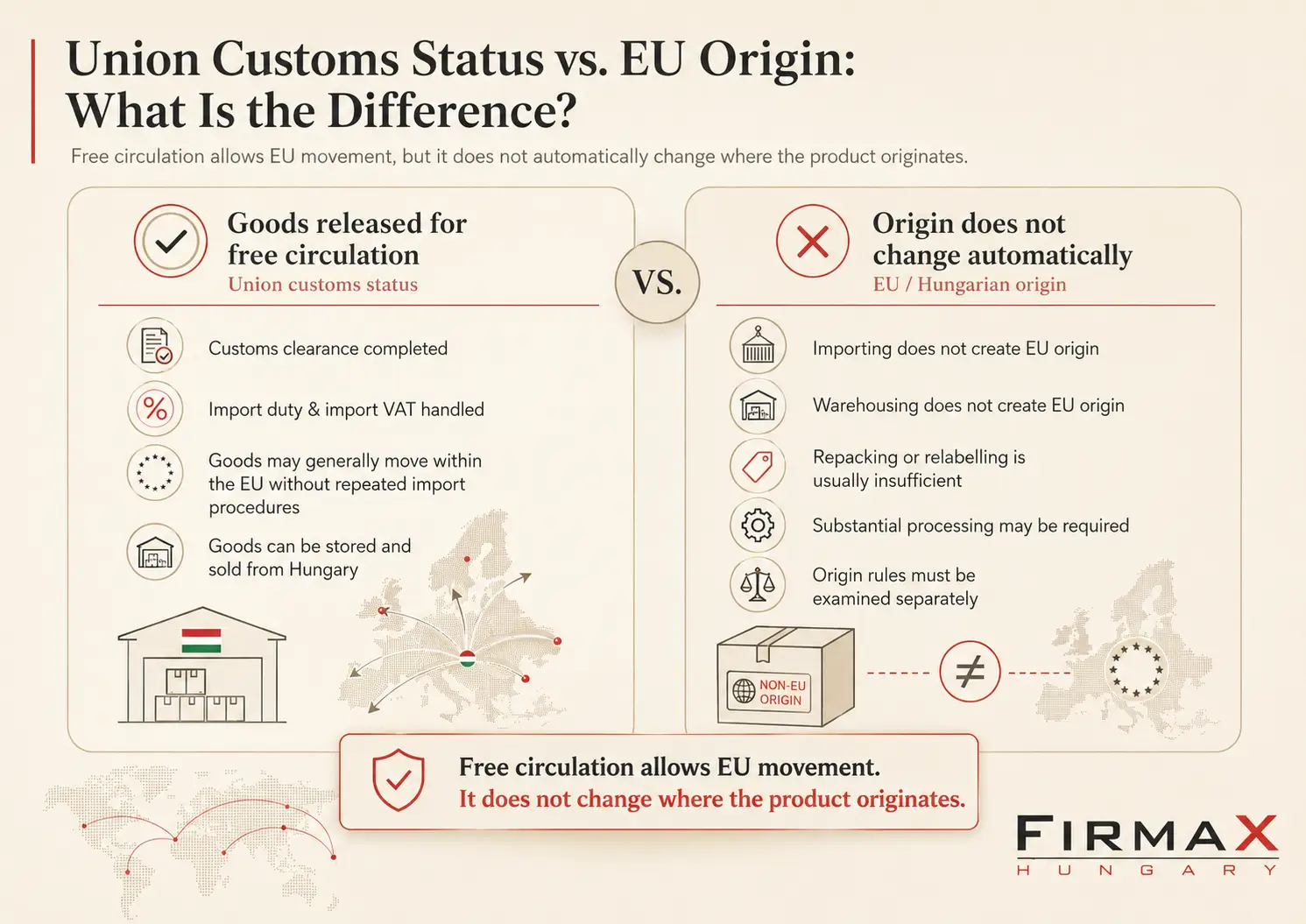
One of the most important misunderstandings in this business model concerns the difference between customs status and origin.
When a product is released for free circulation in Hungary, it obtains Union customs status. This allows it to move within the EU without repeated import customs clearance.
It does not automatically become a Hungarian or EU-origin product.
A product manufactured in China does not become “Made in Hungary” simply because it was imported by a Hungarian company, stored in Budapest or sold from a Hungarian warehouse.
Simple repacking, labelling, sorting or minor assembly will normally not be sufficient to change the product’s origin.
Origin may change only where the goods undergo substantial processing that satisfies the relevant customs-origin rules.
This may depend on a change in tariff classification, the value of non-originating materials or the performance of a specific manufacturing process.
Businesses should be particularly careful with marketing statements such as “Made in the EU” or “European product.” Commercial presentation must not contradict the actual customs origin.
The company’s records should therefore distinguish between Union customs status and country of origin.
- Product compliance remains a separate obligation
Customs clearance does not confirm that a product is legally marketable in the EU.
Before selling imported goods, the Hungarian importer must determine which product-safety, labelling and conformity requirements apply.
Depending on the product, this may involve CE marking, technical documentation, testing, an EU Declaration of Conformity, safety warnings, user instructions or importer identification.
The Hungarian company acting as EU importer may have direct legal responsibility for ensuring compliance.
It cannot simply rely on the non-EU manufacturer’s statement that the product is suitable for the European market.
Where CE marking is required, the company should verify that the correct conformity procedure has been completed and that the supporting technical file exists.
Where CE marking is not applicable, other EU or national product rules may still apply.
Product-compliance work should be completed before the shipment is ordered. Discovering only after arrival that a product cannot legally be sold may result in storage costs, relabelling, testing, return shipment or destruction.
- Documentation from import to final delivery
The documentation system should follow the goods through the entire supply chain.
The import file should contain the purchase contract, commercial invoice, packing list, transport documents, customs declaration, customs-value calculation, classification records, proof of origin and product-compliance documents.
When the goods arrive at the Hungarian warehouse, the stock-entry records should identify the imported batch and its customs status.
For each later sale, the company should retain the customer order, VAT-number verification, sales invoice, delivery note and transport evidence.
The accounting records, customs documents, warehouse system and VAT returns should be capable of reconciliation.
The aim is not simply to collect a large number of documents. The aim is to create one consistent and verifiable story.
An independent reviewer should be able to determine where the products came from, how they entered the EU, where they were stored, who purchased them and how they reached the final customer.
- Common mistakes
Many distribution-hub problems arise before the goods even reach Hungary.
Businesses may select an incorrect customs code, accept an unsupported origin claim, overlook anti-dumping measures or use a company structure that does not match the customs declaration.
After importation, further risks can arise from poor stock controls, unsupported import-VAT deductions or treating customs clearance as proof of product compliance.
For EU sales, the most common errors include failing to verify the customer’s VAT number, issuing a zero-VAT invoice without proof of transport or reporting different information in the invoice and A60 statement.
Another frequent mistake is assuming that goods imported into Hungary automatically acquire European origin.
Most of these issues are significantly easier to prevent than to correct after a customs or tax audit has started.
How FirmaX supports international investors
Building a Hungarian logistics hub requires more than company formation and warehouse space.
The importer structure, customs procedure, VAT treatment, inventory system and sales documentation must work together from the beginning.
FirmaX supports international investors with Hungarian company establishment, tax and EU VAT registration, EORI administration, accounting, VAT compliance and import-process coordination.
We also assist with intra-Community transaction reviews, VIES procedures, transport-document workflows, inventory administration and preparation for NAV inspections.
A properly structured Hungarian company can become an effective bridge between a non-EU manufacturing base and customers across Europe.
The real advantage comes from combining a reliable import process with controlled European inventory, correct VAT treatment, product compliance and well-documented EU distribution.