What happens if the bank does not open an account for a Hungarian company?
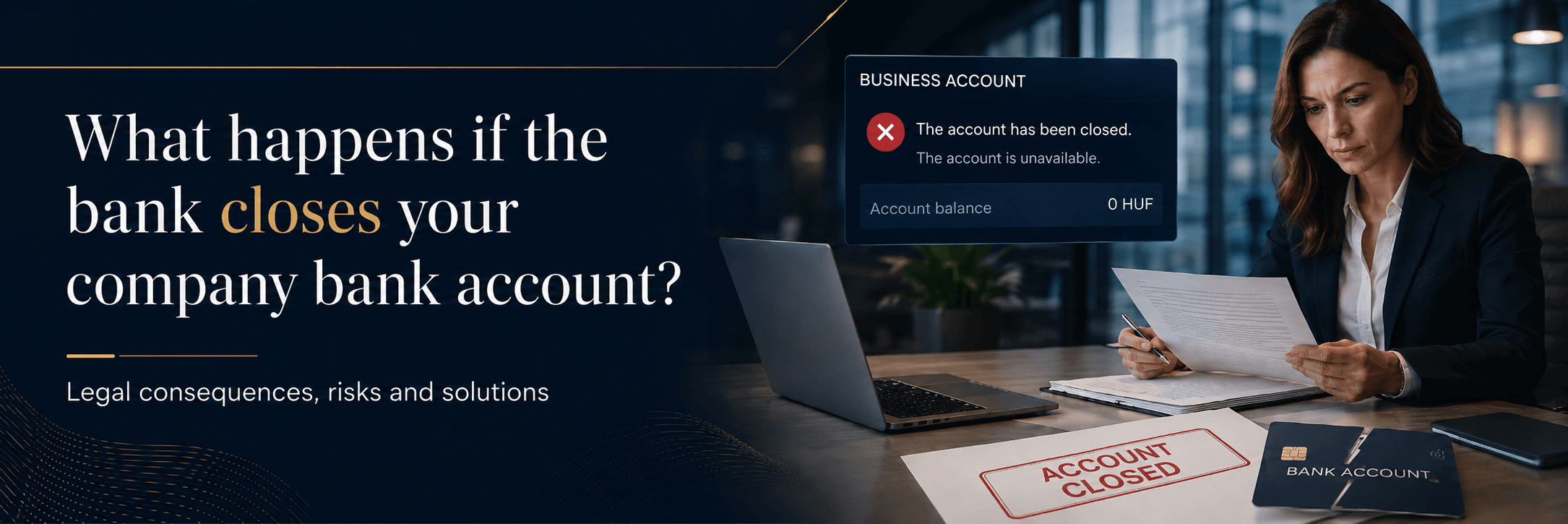
Reasons for rejection of a corporate bank account, legal consequences, temporary solutions and subsequent termination of an account that has already been opened
The establishment of a Hungarian business association does not end with the registration at the Court of Registration. In order to actually operate, the company needs, among other things, a tax number, an accounting background, an appropriate registered office and at least one domestic payment account.
Opening a bank account is seen by many entrepreneurs as a simple administrative step. In practice, however, the bank does not merely provide the company with an account number. As part of the account opening process, you will examine the company, its owners, beneficial owners, managing directors, business activities, expected cash flow and international connections.
Especially in the case of foreign-owned companies, it may happen that the company is already registered, has a tax number, registered office and managing director, but the selected bank does not undertake to maintain the account. A situation may also arise in which the bank branch appears to open the account, the company receives the account number, but later the bank’s central compliance department requests additional documents, restricts the use of the account, or finally terminates the business relationship.
Therefore, it is important to distinguish between the legal establishment of the company and the acceptance by the bank. Company registration in itself does not mean automatic bank approval.
Is it mandatory for a Hungarian limited liability company to open a bank account?
According to Hungarian rules, a domestic legal entity, including a limited liability company, must have at least one domestic current account. The first payment account must be opened within fifteen days of the communication of the tax number. With the exception of the amounts that can be legally held in cash, the company must keep its funds in a cash account and must also carry out its cash flow through such an account.
Therefore, the deadline does not necessarily start on the day of signing the articles of association, and not in all cases on the day of company registration. The law links the fifteen-day period to the date of communication of the tax number.
However, the obligation exists only on the side of the company. The fact that the company is obliged to open a bank account does not mean that the first selected bank is obliged to accept the company’s application. In addition to statutory customer due diligence, the bank may also apply its own risk-taking, country risk, industry and business policy rules.
Therefore, it may happen that the same business is rejected by one financial institution, while another undertakes to maintain the account with appropriate documentation.
Why can the bank refuse to open an account?
During the account opening procedure, the bank must understand with whom it is establishing a business relationship, who manages the company, where the company’s funds come from, and what transactions are expected on the account.
The bank must classify the customer into a risk category, record the purpose and planned nature of the business relationship, and request information and supporting documents on the source of funds on a risk basis. You can also make the establishment of a business relationship subject to responsible management approval.
The most common reasons for an account opening being rejected are:
- the beneficial owner cannot be reliably identified;
- incomplete, outdated or contradictory company documents;
- the source of the company’s financing or the owner’s assets cannot be adequately verified;
- the business model presented is not understandable or does not seem realistic;
- the chain of ownership is too complex or not transparent enough;
- a country, industry or type of transaction with a higher risk is involved;
- the company does not have a properly demonstrable economic relationship in Hungary;
- it is not clear to the bank why the company wants to operate in Hungary;
- there is a risk of sanctions, political public figures or reputation.
If the bank is unable to carry out the customer due diligence required by law, it is not simply entitled but obliged to refuse to carry out the transaction through the account, to establish a business relationship or to complete the transaction. In the case of an existing relationship, you may also be obliged to terminate the relationship.
Identification of the beneficial owner
It is not enough for the bank to know which person or company is the direct owner of the Hungarian Ltd. according to the company register. It must also determine which natural person or persons ultimately exercise decisive ownership or control influence.
A simple, one-person ownership structure is usually easier to screen. The process can be more complex if the Hungarian Ltd. is owned by a foreign company, its owner is another holding company, and the chain of ownership leads to the final natural persons through several countries.
A complex corporate structure is not illegal in itself. However, the bank may request the recent certificate of incorporation, articles of association, ownership diagram, representation documents and identification documents of the final natural persons of all intermediate companies.
If the chain of ownership cannot be clearly documented, or the declaration of beneficial ownership submitted does not match the available registration data, the opening of an account can easily lead to rejection.
Examine the business model
Typically, the bank is not satisfied with the name of the main activity in the company register. You want to understand how the company will actually work.
A general formulation, such as that the company deals with “international trade”, “business consulting” or “online services”, is often not sufficient.
The bank’s questions may include who the company’s customers will be, from which countries the revenues will come, in what currency the invoicing will be made, who the main suppliers are, how much monthly turnover is expected, how many transactions will take place, whether there will be cash flow, and on what grounds the company will transfer abroad.
Opening an account can be facilitated if the company already has a business plan, website, customer or supplier contracts, letters of intent, quotes or other documents that support the business model presented.
Consistency is particularly important in banking communication. If the statement of the managing director, the business plan, the company’s activities and the contracts presented show different operation, it may increase the risk classification.
Source of funds and wealth
The bank can investigate where the money needed to start the company’s operations comes from. Not only the direct source of the first payment can be important, but also the economic background from which the owner acquired the amount invested in the business.
The designation “own savings” alone is not always sufficient. The bank may request a bank statement, income certificate, financial statements of a previous business, a resolution certifying the payment of dividends, a real estate or share purchase contract, an inheritance document or a loan agreement.
The larger the initial amount, the more complex the ownership background, or the higher the risk of financing, the more detailed documentation may be required.
What happens if the company does not open an account within fifteen days?
Failure to comply with the deadline does not mean that the company will automatically cease to exist on the sixteenth day. The tax number is not automatically deleted immediately for this reason alone.
However, the company is in an infringing state. The NAV may first call upon the company to fulfil the obligation with a fifteen-day deadline. If a non-natural person taxpayer fails to open an account despite the notice, he or she may be fined two hundred thousand forints for default, with a further fifteen-day deadline for completion. If this deadline also passes without success, the fine may be HUF 500,000 and a new call for performance may follow.
In addition, the lack of a bank account also significantly restricts the practical operation of the company. The company is unable to provide its customers with a regular corporate account number, it is unable to make its tax, wage and supplier payments in the usual way, and it may also become problematic to receive tax refunds and budget allocations.
The company cannot permanently use the bank account of the managing director, the owner or another company to manage its own business cash flow. This would confuse the assets of the company and the individual or the other company, and would create accounting, taxation and anti-money laundering risks.
Can it be solved temporarily with cash?
The use of cash is not a substitute for a mandatory domestic payment account.
Between two taxpayers obliged to open a payment account, a maximum of one and a half million forints per contract and calendar month may be paid in cash per contract and per calendar month. The restriction cannot be circumvented by artificial contract division.
For the part exceeding the limit, both the payer and the party accepting cash may be subject to a default penalty of twenty percent.
Therefore, some minor initial costs can be settled with cash, but it is not expedient and cannot rely on cash alone for the regular operation of the company.
What transitional options are available?
There is no temporary solution that can completely replace the domestic payment account. However, the duration and economic impact of the problem can be reduced.
If the procedure of one bank is prolonged or ends with a rejection, it may be justified to start opening an account with another financial institution. The risk policy of each bank is different, so a customer rejected by one bank may be acceptable with another bank with appropriate documentation.
A business account with a foreign financial institution or payment service provider can make it easier to manage certain international income and expenses. However, this does not eliminate the Hungarian requirement that a domestic legal entity has at least one domestic payment account.
Certain initial costs may be temporarily advanced by the owner or the managing director. However, the legal title and accounting of this must be accurately documented. Depending on the circumstances, the amount may appear as a member’s loan, an advance payment on costs or a claim against the company.
This option is only suitable for the temporary settlement of individual initial expenses. It is not an appropriate solution for customers to pay regularly to the owner’s private account.
Until the appropriate bank account is available, it may be a good idea to postpone large invoices, international trade in goods, significant supplier commitments, and other activities that require a working corporate account to be properly executed.
Why can the company receive an account number if the due diligence has not yet been completed?
The technical opening of an account and its full usability do not necessarily mean the same thing.
The anti-money laundering rules allow the service provider to open an account even before the identification is completely closed, under certain conditions. However, in such cases, you must ensure that the customer, their representative and the right of disposal cannot take any action until the identification and identity verification is completed.
Therefore, it may happen that the business has already received an account number, but is not yet able to transfer, receive money, use internet banking or use a bank card.
The document recording carried out by the branch clerk is often followed by an additional central check. The central compliance department may request additional ownership documents, a detailed business plan, proof of cash sources, contracts or a more accurate presentation of the planned cash flow.
Therefore, the issuance of the account number does not in itself mean the final and unconditional closure of the bank due diligence in all cases.
Why can the bank terminate an account that is already in operation?
The bank’s customer due diligence obligation does not end with the opening of the account. The bank must continuously monitor account turnover throughout the business relationship and examine whether the transactions carried out are in line with the information previously received about the customer. If the customer’s risk profile changes, the bank must carry out additional due diligence measures.
For example, it may be a risk if the company indicated a low monthly turnover when opening the account, but later receives significant amounts in a short period of time. Questions may also arise if, instead of the reported advisory activity, transactions appear on the account that are largely reminiscent of the trade in goods or the transfer of money from third parties.
The bank may also request additional documents in the event of a change in the company’s ownership, beneficial owner, managing director, activities or the scope of its main partner countries. Based on the anti-money laundering rules, the client must notify the service provider within five working days of becoming aware of any change in the data disclosed during the due diligence or in the person of the beneficial owner.
The termination of the account may also be caused if the company does not respond to the bank’s requests for data updates, fails to verify the title of a major transaction, fails to present the source of the money, or subsequently turns out to have concealed an essential circumstance when opening the account.
How can the bank terminate the contract?
The framework agreement for an indefinite period may stipulate that the bank may terminate the contract. As a general rule, a notice period of less than two months may not be applied. A shorter notice period is possible if the customer has seriously or repeatedly breached its contractual obligation. Upon termination of the contract, the parties must settle accounts with each other.
However, in the case of data, facts or circumstances indicating money laundering or terrorist financing, special rules may apply. The bank may terminate the business relationship with immediate effect if there is a risk that it will be involved in the execution of criminal transactions due to the continued use of the account during the notice period.
In such a case, the bank may not provide a detailed explanation to the customer. Its information options in relation to anti-money laundering procedures may also be affected by legal restrictions.
What happens to the money in the account?
The termination of the bank account does not in itself mean that the bank acquires the company’s money. Upon termination of the contract, the parties are obliged to settle accounts with each other, and as a general rule, the bank is only entitled to the proportionate consideration of the service actually provided.
During the notice period, it is advisable for the company to open another account, inform its customers and partners of its new account number, modify the standing orders, and dispose of the transfer of the remaining balance.
The situation is different if the money in the account is subject to an official measure, enforcement, criminal blocking or financial sanction. In this case, the bank may not be able to transfer the amount freely, even if the account agreement is terminated.
When I buy a Shelf company, do I automatically keep my bank account?
Not necessarily.
A pre-registered company may have an existing bank account, but the bank originally looked at the previous owner, beneficial owner, managing director and business model.
After the sale of the company, the ownership structure, the managing director, the company name, the activity, the range of partner countries and the expected cash flow may change. These changes may warrant a new due diligence and risk assessment by banks.
The bank can accept the new structure, but it can also ask for additional documents, restrict the use of the account, or decide that it does not want to maintain the account management relationship with the new risk profile.
Therefore, an existing bank account of a shelf company cannot be considered as an automatically guaranteed and indefinitely usable bank account.
How can I reduce the risk of rejection?
It is advisable to prepare for opening an account before establishing or taking over the company. In the case of foreign ownership, it is especially important to document the entire ownership chain, clearly identify the beneficial owners, verify the source of the money and present the planned business model in detail.
Uniform and consistent documentation must be submitted to the bank. Company documents, business plans, contracts, expected turnover figures and the CEO’s responses must present the same operating model.
The goal is not for the company to provide the bank with as little information as possible. Transparent, accurate and verifiable communication usually significantly improves the chances of the bank understanding and classifying the company’s operations as acceptable.
The role of FirmaX in bank preparation
FirmaX manages the processes related to the establishment of the Hungarian company, the takeover of the shelf company, the accounting onboarding and the operational setup of the company in a unified manner.
During the preparation of the bank, we can help with the documentation of the ownership structure, the collection of the necessary Hungarian and foreign company documents, the settlement of the actual ownership data, the presentation of the business model, and the compilation of the documentation necessary for banking issues.
At the same time, it is important to note that the final approval of the opening of an account is always decided by the bank itself. Neither the establishment of the company, nor the purchase of the shelf company, nor the professional preparation of the documentation are a substitute for the bank’s own customer due diligence and risk assessment.
Therefore, the goal is not to provide an unfounded bank account guarantee, but to create a transparent and properly documented corporate structure that is understandable and verifiable for the bank, the accountant, the authorities and business partners alike.
Conclusion
A Hungarian Ltd. must open at least one domestic payment account within fifteen days of the publication of the tax number. However, the obligation of the company does not mean that the first selected bank is obliged to accept the application to open an account.
The bank may reject the company if the customer due diligence cannot be carried out properly, the ownership background is not transparent, the source of the money cannot be verified, the business model is not understood, or there is a higher country, industry, sanction or reputation risk.
If the company does not open an account in time, it will not be automatically terminated, but it can expect a notice from the National Tax and Customs Administration (NAV) and significant default penalties. In addition, the lack of a bank account also greatly limits the actual operation of the business.
An account that has already been opened is not necessarily final. The bank monitors the customer and their transactions throughout the relationship. In the event of a change of ownership, change of managing director, missed data update, a changed business model or inadequately verified cash flow, you may apply further investigation, restriction or account termination.
Therefore, the most important thing is to prepare in advance: a transparent ownership structure, a documented source of funds, a realistic business model, unified bank communication and a transaction profile that is in line with actual operation.