What financial indicators should the managing director of a limited liability company monitor on a monthly basis?
Managerial financial control at Hungarian companies
The financial management of a limited liability company does not begin with the preparation of the annual report, nor does it end with the submission of the returns by the accounting deadline. Compliance with the law is a basic requirement, but it does not in itself provide sufficient information on whether the company operates in a commercially stable, financeable, profitable and controlled manner from a risk management point of view.
The responsibility of the managing director at the management level is not to record accounting entries, but to be able to draw business conclusions from the financial information available to him. For this, it is not enough to review the profit and loss account at the end of the year or the balance sheet. The company’s operations must be evaluated on a monthly basis, based on appropriately designed management reports, financial indicators and control points.
Monthly financial indicators are not just about showing past performance. The essence of professional financial reporting is to indicate operational, liquidity, tax, financing and profitability risks in a timely manner. A well-structured monthly dashboard shows not only how much revenue or profit there was, but also whether the company’s business model is sustainable, whether growth can be financed, whether the cost level is justified, and whether the company is able to meet its short- and medium-term obligations.
In the case of limited liability companies, it is especially important that the managing director does not evaluate the numbers exclusively from an accounting perspective. The same data may have different significance from an accounting, tax, banking, ownership or operational management perspective. For example, a high revenue can be a favorable business signal, but if it is stuck in receivables, realized with a low margin, or involves a disproportionate increase in costs, it can actually increase the company’s risk profile.
Therefore, the monthly financial control must examine the company in several dimensions: profitability, liquidity, working capital, cost structure, tax position, financing, ownership transactions, internal controls and business performance.
- Revenue: volume, structure and quality
Sales revenue is the first indicator that most CEOs observe, but it carries only limited information in itself. When analysing monthly revenue, it is not sufficient to examine the total amount. The management report must also cover the structure, source, sustainability and realisability of the revenue.
In the case of a limited liability company, it is expedient to treat domestic and foreign sales revenues, one-off and recurring revenues, revenues from main and ancillary activities, as well as a breakdown based on customers, business lines or projects separately. In the case of international operations, foreign currency sales deserve special attention, as exchange rate changes, VAT treatment, place of performance and the timing of cash receipt may have a significant impact on actual profit and cash flow.
Issues relevant to the executive are the following:
What was the monthly revenue compared to the plan? How did it compare to the previous month and the same period last year? What is the percentage of revenue that comes from returning customers? Is there excessive customer concentration? Is the growth organic and sustainable, or is it caused by a one-time item? Did the money related to sales revenue really come in or did it appear as a trade receivable?
Customer concentration rate can be a key indicator. If one or a few customers account for a significant part of the total revenue, it is not only a sales risk, but also a financing and operational risk. The loss of a large customer, a late payment or a change in the terms of a contract can have an immediate impact on a company’s cash flow and profits.
The proportion of recurring income is also important. For a company operating in a service or subscription model, stable, contractually recurring revenue is more valuable than the same amount of unpredictable project revenue. Therefore, it is advisable for the management report to present separately the ratio of recurring revenue, project revenue and occasional revenue.
- Gross margin and margin level
The analysis of sales revenue must be directly followed by the analysis of gross margins. The gross margin shows how much of the sales revenue is left after deducting the directly related costs. This is one of the most important business performance indicators because it shows the income-generating capacity of the company’s core business.
The formula for gross margin is simple:
Gross margin = Revenue – direct costs
Gross margin in percentage form:
Gross margin % = gross margin / revenue × 100
The scope of direct costs may vary from activity to activity. In the case of a trading company, this may include the acquisition value of the goods sold, in the case of a manufacturing company, the cost of materials and direct production costs, and in the case of a service company, the subcontractor fee, project work, direct labor or performance-related costs.
In the case of management-level interpretation, the total company-wide gross margin is not sufficient. It is also advisable to examine it by customer, product, service, project or business unit. A common problem is that a company appears to be profitable overall, but certain customers or services are actually unprofitable because they require a disproportionate amount of subcontracting, administrative or labor input.
A deterioration in gross margin can be an early warning sign. It can indicate poor pricing, rising purchase costs, excessive discounting, incorrect project calculation, currency exchange rate effects, inappropriate contract terms, or inefficiencies in the delivery process.
In a professional management report, gross margin is not only accounting data, but also a pricing, sales and strategic control point.
- EBITDA, operating profit and profit before tax
During the monthly performance review, the managing director has to monitor several levels of results. The total result alone is not enough, because it is affected by various factors: core business, depreciation, financing costs, exchange rate effects, one-off items and tax liabilities.
One of the most commonly used management indicators is EBITDA, i.e. earnings before depreciation, interest and taxes. Although it is not a separate mandatory line in the Hungarian accounting report, it can be a useful indicator from a management and financing point of view, because it brings us closer to the evaluation of operational performance.
EBITDA = operating profit + depreciation and amortization
EBITDA is important because it filters out the impact of depreciation and better shows the operating profit that the core business can generate. At the same time, it should not be treated as cash flow because it does not include, for example, changes in working capital, investments, loan repayments and tax payments.
The operating profit shows whether the company’s core business is profitable, taking into account operating expenses. This is of paramount importance from a managerial point of view, because it shows whether normal business operations can be sustained.
The pre-tax profit already takes into account financial and other items. This is relevant from the point of view of dividend planning, bank judgement, equity development and corporate tax.
In the monthly report, it is advisable to present the one-off, non-recurring items separately. Such can be, for example, a sale of assets, damages, exchange rate gains, write-offs, litigation items or one-off advisory costs. These can distort the result of the given month, so it is worth calculating a normalized result for management decisions.
- Cost structure and expense ratio
Examining costs is not the same as reducing costs. The goal of professional financial management is not to minimize all costs, but to ensure that the cost structure is in line with the company’s business model, revenue, growth strategy and risk capacity.
During the monthly cost analysis, it is advisable to isolate:
fixed costs, such as office, rent, software, basic salary, accounting, insurance;
variable costs, such as material costs, subcontractors’ fees, commissions, performance-related costs;
discretionary costs, such as marketing, event, consulting, training;
one-off costs, such as legal proceedings, preparation of investments, restructuring.
The expense ratio indicator:
Expense ratio = given expense group / sales revenue × 100
In the managerial interpretation, the wage cost ratio, the subcontractor cost ratio, the marketing cost ratio, the ratio of administrative costs and the development of financing costs are particularly important.
An increasing expense ratio is not necessarily a negative sign if the company is consciously investing in growth, new markets, capacity or systems. A risk arises when the increase in costs does not bring a measurable improvement in revenue, efficiency or quality.
Special management attention is required for the so-called operating leverage, i.e. how the fixed cost level affects the result in the event of a change in revenue. In the case of a company with high fixed costs, even a slight decline in sales can cause a significant deterioration in profits. With a lower fixed cost level, the company adapts more flexibly to market changes.
- Cash flow and liquidity position
Liquidity refers to the short-term solvency of a company. The difference between accounting profit and liquidity is one of the most important basic management financial knowledge. A company can be profitable while facing liquidity problems if customers pay late, there is money in stock, or tax and wage payment obligations are ahead of the receipt of revenues in time.
On a monthly basis, it is not enough to view the bank account balance. The managerial cash flow report shall include:
the opening cash stock, the actual cash inflows, the actual outgoing cash flows, the closing cash stock, the expected customer receipts for the next period, the tax, wage, supplier and financing payments due for the next period.
In the case of professional operation, a rolling cash flow forecast of at least 8 to 13 weeks is recommended. This is especially important for companies with significant project financing, inventory requirements, export-import activities, large corporate customer base or seasonal revenue.
Key liquidity indicators:
Current ratio = current assets / current liabilities
Quick ratio = cash and cash equivalents + current receivables / current liabilities
Cash ratio = cash and cash equivalents / current liabilities
These should not be interpreted mechanically, but in a business context. In a trading firm, the current ratio may seem favorable due to the high proportion of stock, but if the stock is slow-trading or difficult to sell, the actual liquidity position may be weaker.
- Accounts receivable and DSO
The receivables of the customer directly affect the financing needs of the company. An invoice issued but not paid may appear as sales revenue, but it is not yet a financially usable resource. Therefore, receivables are not an accounting side topic, but a management risk indicator.
The monthly report must include the aged receivables statement, i.e. the aged breakdown of trade receivables:
Unexpired, 1–30 days overdue, 31–60 days overdue, 61–90 days overdue, more than 90 days ago.
DSO is a key indicator:
DSO = Average Trade Receivables / Sales Revenue × Number of Days
DSO shows the average number of days in which buyers pay. If the DSO rises, it typically indicates deteriorating collection discipline, poorer customer quality, excessively long payment terms, or inadequate debt management.
Debt management is a managerial issue. Already at the conclusion of the contract, attention must be paid to the advance payment, partial invoicing, certificate of completion, late payment interest, suspension of service, credit limit and payment discipline. Receivables management does not start when the invoice is overdue, but when the company gives the customer a payment term.
- Trade payables, DPO and payment discipline
Monitoring accounts payable is just as important as analyzing accounts receivable. An excessively high or overdue supplier portfolio can indicate a solvency risk for the company and can also cause business reputation problems.
The DPO ratio:
DPO = Average Supplier Debt / Purchase or Operating Costs × Number of Days
The DPO shows the average number of days in which a company pays its suppliers. A longer payment term can improve cash flow, but only if it does not result in a loss of supplier confidence, late costs, delivery risk or worse contract terms.
From the point of view of the managing director, it is important to see whether the operation of the company is based on the financing of suppliers. If the company regularly pays late, it is not a sustainable financing strategy, but a liquidity risk.
- Working capital and cash conversion cycle
Working capital shows the financing requirement required for the company’s day-to-day operations. According to the classic approach:
Net working capital = inventories + accounts receivable – trade payables
The development of working capital is particularly important in the growth phase. In many cases, rapid revenue growth does not generate money immediately, but ties up money. More inventory, more pre-financed projects, more employees and higher accounts receivable may be required.
The cash conversion cycle indicator shows the number of days it takes for a company to convert the money invested in its operations back into cash.
CCC = DIO + DSO – DPO
where:
DIO = Inventory Rotation Days, DSO = Customer Payment Days, DPO = Vendor Payment Days.
The longer the cash conversion cycle, the greater the financing requirement for the operation. This is not necessarily a problem, but it requires a conscious financing plan. The company cannot treat growth in the same way if it involves an immediate inflow of cash as if it requires significant pre-financing.
- Tax burden and tax cash flow
Monthly monitoring of the tax burden is not just a matter of compliance. Corporate tax, local business tax, VAT, wage contributions, rehabilitation contribution, company car tax or other public charges can cause significant cash flows. You have to plan for these in advance.
At the management level, it is not enough to know that the tax returns have been filed. The managing director should see:
in which tax types are expected payment obligations, when they are due, what is the size of the tax account balance, whether there is an overpayment or debt, how the VAT position will develop, what impact the profit will have on corporate tax and dividend planning.
The cash flow effect of VAT is particularly important. If the company invoices the customer for the performance, but the customer pays late, while the VAT payment obligation becomes due earlier, the company must finance the tax from its own resources.
In the case of international transactions, the tax risk may increase further. EU and third-country partners, reverse charge, EU tax number, foreign currency invoicing, import VAT, place of supply and permanent establishment are all areas where financial reporting and tax advisory control must be linked.
- Wage cost, capacity and productivity
Wage costs are not only a cost line, but one of the most important indicators of the company’s capacity and operating model. In a service or knowledge-based company, the workforce capacity directly determines the ability to generate revenue.
In the management report, it is advisable to pay attention to:
Total wage costs and contributions, ratio of wage costs to sales revenue, sales revenue per capita, gross profit per capita, ratio of billable hours, overtime, fluctuation, financial impact of new entrants and exits.
The formula for the wage cost ratio:
Wage cost ratio = total employee-related expenses / sales revenue × 100
This should be interpreted differently from industry to industry. Of course, it can be higher for a consulting firm, while a different cost structure is justified for a commercial company. The key is not absolute value, but trend and productivity.
If wage costs increase faster than sales revenue or gross profit, the company’s profitability may deteriorate. If, on the other hand, the increase in wage costs supports new capacity, better customer service or higher margins, it may be strategically justified.
- Equity, dividends and ownership transactions
The development of equity is not only a matter of annual financial statements. From the point of view of the company’s financial stability, ability to pay dividends, bank perception and long-term operational security, it may require attention on a monthly or quarterly basis.
The managing director must pay attention to equity in particular if the company is loss-making, plans to pay a large dividend, launches a significant investment, uses bank financing or finances its operations through shareholder loans.
Proprietary transactions should be treated separately:
granting of a member’s loan, repayment of a member’s loan, dividend advance, dividend, executive expense allowance, private use, owner payment.
The mixing of company money and private money can cause serious tax, accounting and managerial liability risks. Therefore, the professional management report must transparently present the financial relationship of the owners and managing directors with the company.
- Financing, indebtedness and bank indicators
If the company uses loans, leasing, factoring or owner financing, the monthly report must also include an analysis of the financing position.
Important indicators can be:
Net debt = interest-bearing liabilities – cash and cash equivalents
Net debt / EBITDA
Interest coverage ratio = EBITDA / interest expense
Debt service coverage ratio = operating cash flow / loan repayment and interest
These indicators are not only relevant for bank financing. They also provide basic information on ownership decisions, dividend policy, investments and growth strategies.
A bank or investor does not look solely at the outcome. The stability of cash flow, the quality of receivables, the need for working capital, the financing structure, tax compliance and the reliability of management reporting are also important to him.
- Plan-fact analysis and deviation analysis
One of the most important parts of the monthly financial report is the budget versus actual analysis, i.e. the comparison of plan and actual data. This is what distinguishes a mere accounting statement from a management control system.
In the course of the plan-fact analysis, it is not enough to establish that a line deviated from the plan. The reason, nature and expected recurrence of the deviation must be determined.
The difference may be:
revenue variance, volume deviation, price effect, cost difference, timing deviation, one-off item, exchange rate effect, efficiency deviation or structural deviation arising from the business model.
The managerial question is not “why is the number different”, but what kind of decision the deviation requires. Need to change pricing? Should cost control be introduced? Do you need to renegotiate payment terms? Need new capacity? Or was the plan unrealistic?
Plan-fact analysis works well if the company has an annual or rolling financial plan. Without it, the monthly report only shows historical data, but does not provide an adequate measure for evaluating performance.
- Compliance, internal control and data quality
The reliability of financial indicators depends on data quality. If the accounts are entered into the accounts late, the bank items are not identified, the cash balance does not match, or the contracts are not available, the management report will not be accurate either.
Therefore, it is advisable to check on a monthly basis:
whether all bank statements have been processed, whether the open items of the customer and the supplier are the same, whether the cash portfolio is substantiated, whether the salary data is complete, whether the tax current account is settled, whether the main contracts and certificates of performance are available, whether the foreign currency items have been recorded at the appropriate exchange rate.
Internal control is not just a corporate concept. In the case of a limited liability company, it is also necessary to determine who can approve payments, who can manage a cash register, who can access the bank account, who is authorized to sign a contract, and what document is required to account for an expense.
Weak internal control can lead to financial losses, tax risks, ownership disputes or even management liability issues.
- Suggested monthly executive dashboard
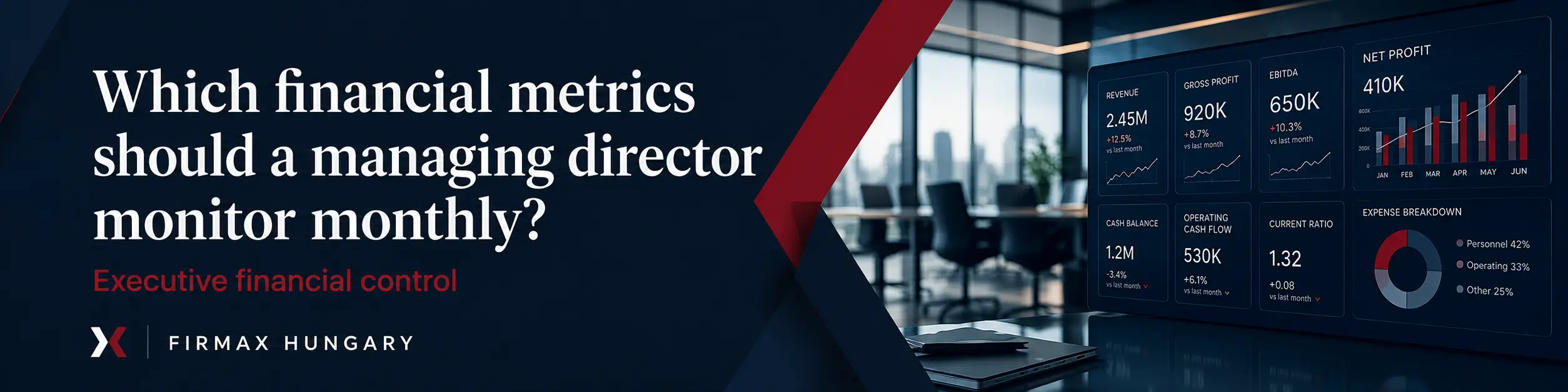
A well-functioning monthly financial dashboard is not necessarily extensive, but structured, consistent and decision-oriented. The following groups of indicators are recommended:
Growth and revenue: revenue, change in revenue, recurring revenue ratio, customer concentration, revenue of new and existing customers.
Profitability: gross margin, EBITDA, operating profit, profit before taxes, normalized profit.
Cost control: main cost groups, cost ratios, wage cost ratio, return on marketing costs, ratio of fixed and variable costs.
Liquidity: bank account balance, available cash, 8-13 week cash flow forecast, current ratio, quick ratio.
Working capital: accounts receivable, accounts payable, inventory, DSO, DPO, DIO, cash conversion cycle.
Tax and compliance: expected tax payments, VAT position, tax current account, return status, deadlines.
Financing: loan portfolio, leasing, interest expense, net debt, repayment capacity, bank covenant indicators.
Ownership position: equity, member loan, dividend planning, owner withdrawals, related party transactions.
The value of the dashboard is not given by the number of indicators, but by the fact that they are displayed consistently, with the same methodology, in a comparable way and with a managerial explanation.
Conclusion
The managing director of a limited liability company does not have to think like an accountant, but he must interpret the operation of the company from a financial management perspective. Monitoring monthly financial indicators is not an additional administrative task, but one of the basic tools of responsible management.
Revenue, profit, expense ratio, tax burden, receivables and liquidity are important in themselves, but they are not enough. These must be supplemented with margin, working capital, cash flow, wage costs, financing, equity, compliance and plan-fact indicators.
The essence of professional financial control is that the company should not only see problems after the fact, but also identify risks in advance. A well-designed monthly report helps with pricing decisions, cost control, tax planning, liquidity management, bank negotiations, ownership decisions and long-term business stability.
Settled accounting is a necessary basis. However, managerial financial reporting is a higher level than this: it is a decision support system that connects accounting data with business reality. A professionally operating Ltd. knows not only how much its revenue and profit were, but also what it came from, how sustainable it is, how much money it actually generated, what risks it carries, and what management decisions are needed in the coming period.